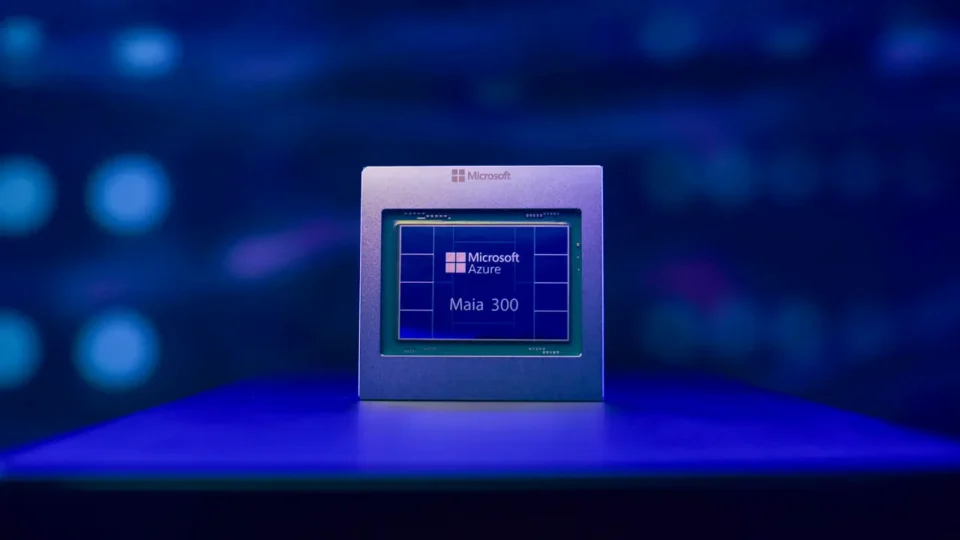
Microsoft Maia 300 AI chip is the company’s new in-house accelerator for large models in Azure data centers. It is not a consumer graphics card. Microsoft designed the silicon together with servers, networking, cooling and software, so the useful comparison is the performance and cost of the whole system rather than a single chip specification.
Microsoft Maia 300 AI chip as a platform
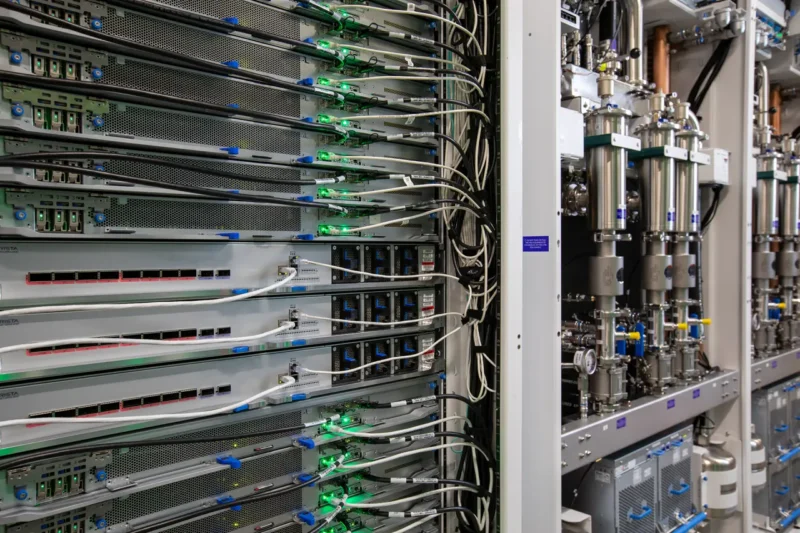
Large AI workloads depend on memory bandwidth, communication between accelerators and efficient cooling as much as raw arithmetic. Co-designing these parts can reduce bottlenecks and let Microsoft tune the platform for its own cloud services. It can also give the company more control over capacity when demand for third-party accelerators is high.
The platform is intended for both training and inference. Training requires sustained parallel work across many processors, while inference must answer users quickly and economically at large scale. The best hardware for one task is not always the best for the other, which is why production measurements matter more than a short synthetic benchmark.
Developing custom silicon does not mean Azure will stop offering NVIDIA or AMD systems. Cloud customers use different frameworks and require different compatibility levels. A mixed infrastructure gives Microsoft more options, while customers still need clear information about pricing, availability and supported software.
Efficiency must be measured in production
AI data centers consume substantial electricity and place pressure on power delivery and cooling. More operations per watt can lower the cost of a request and allow a facility to handle more work. However, utilization, model architecture, batch size and software maturity can change the outcome, so manufacturer claims need production validation.
The relevant metric is total cost of ownership: hardware, energy, cooling, maintenance, software development and migration. A fast accelerator can still be a poor choice if teams must rewrite models, lose observability or depend on immature tools. Azure customers need stable libraries, documentation and a predictable support lifecycle.
Before moving a workload, teams should record the current number of tokens, average and peak latency, throughput and cost per user session. A pilot should use the same model, representative data and equivalent security controls. Without a baseline, it is impossible to demonstrate that a new accelerator produced a meaningful improvement.
Security and portability also matter
An accelerator can process proprietary models, personal data and confidential prompts. Azure must provide tenant isolation, access controls, audit logs and reliable memory clearing between workloads. Those controls should be evaluated alongside speed and price, especially for regulated or sensitive applications.
Custom cloud hardware may reduce costs, but it can also deepen platform lock-in. Teams should keep data formats, evaluation tools and deployment pipelines as portable as practical. Export options and a tested migration plan remain useful even when the chosen platform performs well.
What to watch next
The next important step is production availability. Customers need instance or service details, regional capacity, prices and reproducible measurements on known models. Compiler stability and framework support will be just as important as the silicon because specialized hardware cannot reach its potential without a mature software layer.
The Microsoft Maia 300 AI chip confirms a broader trend: major cloud providers increasingly design their own accelerators. That can bring more competition and better efficiency, but the value will be proven only when real services offer a stronger balance of cost, latency and reliability.
Technical details and official images were checked in Microsoft’s Maia 300 announcement. For another recent cloud-software topic, read our Google Workspace Studio automation overview.
Capacity planning will also determine whether customers benefit. A specialized accelerator can be efficient when it is kept busy, but idle hardware or poorly batched requests can erase theoretical gains. Microsoft must expose monitoring data that lets teams understand utilization, queues and failure rates without turning the service into a black box.
Organizations should compare the platform with their existing deployment using the same quality tests. Lower cost is not useful if model output degrades, safety filters behave differently or operational recovery becomes harder. Performance, output quality and governance need to be evaluated together.