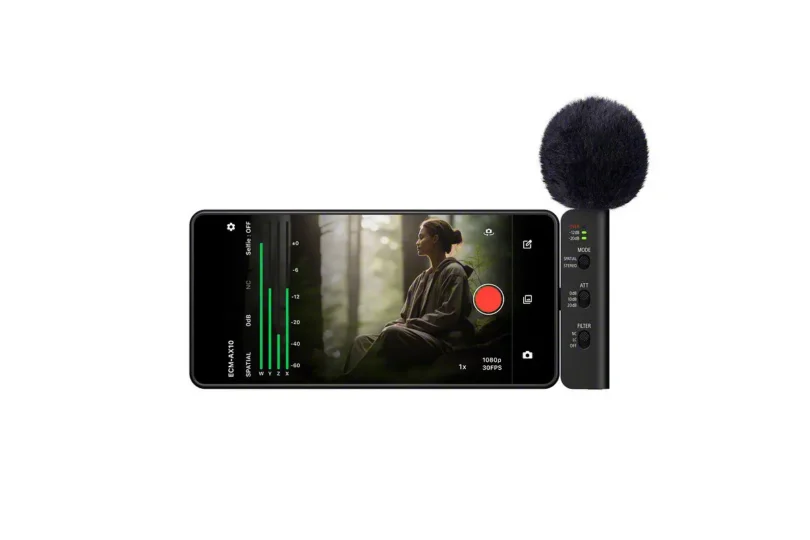
Sony ECM-AX10 spatial microphone is the focus of this report; the verified facts, practical implications and limitations are set out below.
Sony’s ECM-AX10 addresses a familiar weakness in mobile video: phone cameras have advanced faster than the audio that accompanies their footage.
A small microphone with a wider sound field
The ECM-AX10 uses four omnidirectional capsules to capture more than conventional left and right channels. Sony offers Ambisonics recording for flexible post-production, binaural output designed for headphone listening, and a standard stereo mode. Creators can choose a delivery format based on the project rather than forcing every recording into the same workflow.
At approximately 24 grams, the microphone is intended to connect directly to a phone without a separate field recorder. That can reduce the amount of equipment carried by vloggers, journalists and small production teams. Compact size does not remove the need for careful placement, wind protection and a test recording before an important event.
What Eclipsa Audio certification means
Sony describes the ECM-AX10 as the first spatial microphone for smartphones certified for Eclipsa Audio. Certification confirms an element of a spatial-production chain, but it does not make every recording three-dimensional on every device. Playback still depends on the export format, the application, the distribution platform and the device used by the audience.
Ambisonics is useful when a creator wants to preserve more directional information and decide on the final presentation later. Binaural output is more direct for audiences using headphones, while stereo remains the safest option for broad compatibility. The ability to choose between them is more valuable than the spatial label alone.
Don’t miss this



Phone compatibility
According to Sony, supported devices need iOS 18 or later or Android 14 or later, together with USB-C. An operating-system version is not the only requirement. The recording app needs to recognize the microphone and selected format, and the phone must provide a stable connection and sufficient power. Buyers should test the exact device and app combination before relying on it for production.
Sony also offers Spatial Video Tool for a corresponding workflow. That can interest creators already working with spatial video, but many users will care more about clean dialogue and reliable stereo. The hardware does not require every project to become a complex post-production exercise, which keeps it useful for conventional mobile video.
Who it is for
The ECM-AX10 makes the most sense for creators recording events, ambience, interviews or material intended for headphones. A spatial recording can communicate a location more convincingly than a phone’s built-in microphone. For speech in a noisy environment, a directional lavalier or shotgun microphone may still be more practical because it rejects more off-axis sound.
Sony’s US suggested price of $249.99 places the device above ordinary phone accessories. It is a specialized creative tool rather than an essential upgrade for every user. European pricing can differ because of taxes, distribution and packaging, so the US figure should not be treated as a direct local conversion.
Practical assessment
The main value of the ECM-AX10 is not the word spatial, but format flexibility and a compact USB-C workflow. A creator can start with a phone and adapt the sound to different destinations later. If the phone and application support the modes reliably, the microphone can replace a more complicated kit when speed and mobility matter.
Before purchasing, users should check Sony’s compatibility list, support in their preferred app and how the microphone mounts with a case or rig. They should also consider where the audience will listen. Stereo remains a safe choice for general social video, while the other modes have more value for headphones and spatial productions. For related consumer-device coverage, see our report on Amazon Alexa tablets with Google Play.
Don’t miss this
Sony ECM-AX10 spatial microphone: practical checks
The Sony ECM-AX10 spatial microphone needs a practical check of the complete recording chain, not only the connector. The phone, operating system and recording app must recognize the selected mode, while the export workflow must preserve a format supported by the destination platform. Creators should make a test recording before an important event, checking levels, wind noise and mounting position. For speech in a noisy space, a directional or lavalier microphone may still produce a cleaner result than a wide spatial capture.
Its price and purpose place the device in a specialist category for creators, journalists and small production teams. The Sony ECM-AX10 spatial microphone makes the most sense when ambience and direction contribute to the story, particularly for headphone listening. Stereo remains the most compatible option for ordinary social video. Buyers outside the United States should wait for local pricing, warranty details and the official compatibility list instead of treating the US suggested price as a direct conversion.
Key information was verified against the official Sony Electronics announcement; availability and compatibility details may vary by market.