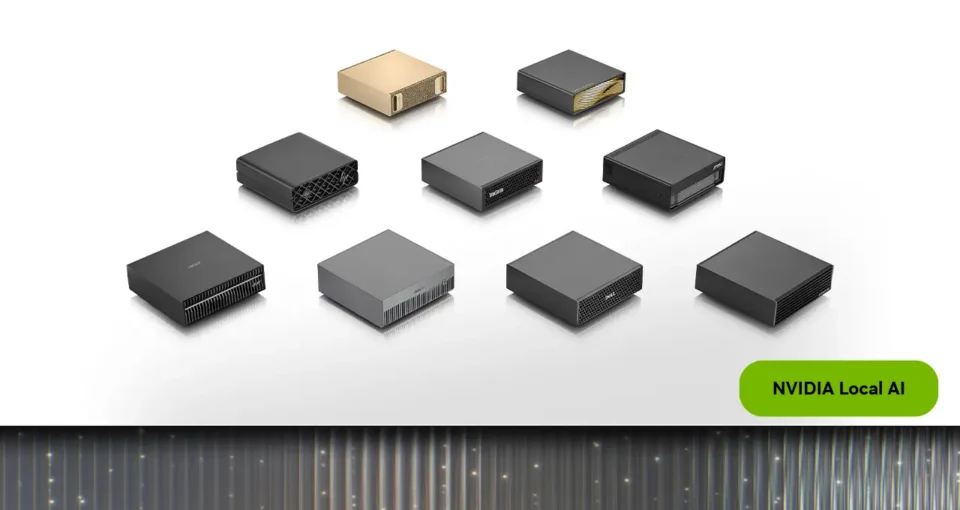
NVIDIA DGX Spark 64GB price and release date are now official. NVIDIA says the upgraded compact AI workstation will be available on October 23 through Acer, ASUS, Dell, Gigabyte, HP and MSI, starting at $4,999 in the United States. Those are manufacturer details, not a confirmed price or availability promise for every country. Read the official NVIDIA announcement for the primary specifications.
NVIDIA DGX Spark 64GB price and release date
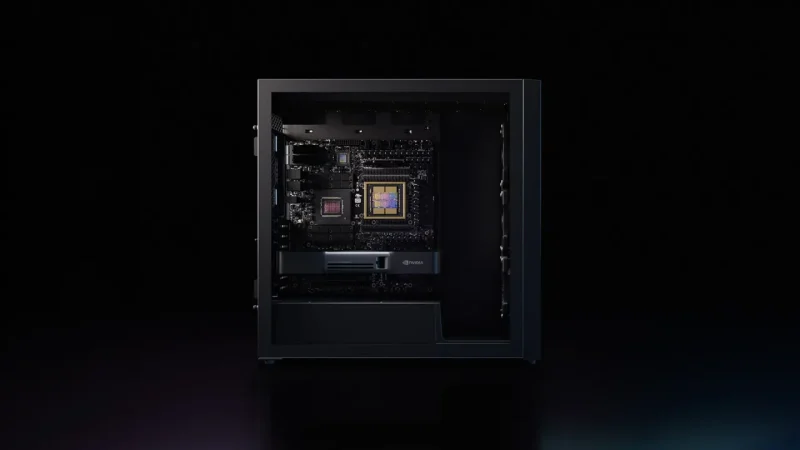
NVIDIA DGX Spark 64GB price and release date matter because the new configuration doubles unified memory while keeping the small desktop format. The GB10 superchip combines a Grace CPU and Blackwell GPU, allowing both processors to work from the same memory pool. NVIDIA says one system can run local models with up to 100 billion parameters, although usable limits depend on quantization, context length and software overhead.
What changes with 64GB of unified memory
Unified memory reduces the need to copy large tensors between separate CPU and GPU memory spaces. That can simplify local model development, fine-tuning and inference, especially when a workload is too large for a conventional graphics card. It does not make every model fast. Memory bandwidth, kernel support, prompt length and framework optimization still determine whether a particular workload is practical.
DGX OS provides NVIDIA’s prepared software environment, including drivers, containers and development tools. The workstation is aimed at developers and research teams that want to prototype locally before moving a project to larger infrastructure. Independent testing will still be needed for power use, acoustics, sustained performance and compatibility with popular open-source model stacks.
NVIDIA Sync connects two systems
The new NVIDIA Sync feature links two DGX Spark units so a workload can use a combined 128GB memory pool. NVIDIA says the paired configuration can address models with as many as 200 billion parameters and delivered up to 1.7 times the performance in its Qwen3.8 27B test. That figure is a vendor benchmark, not a universal result.
Two linked computers are not identical to one machine with 128GB of memory. Software must partition the model and coordinate data between systems, which adds communication overhead. Buyers should confirm that their framework supports the topology, that the required connection is available and that the workflow benefits from distribution. Smaller models may remain easier and cheaper on a single unit.
Don’t miss this


Who should consider it
The clearest audience includes teams building local assistants, testing private datasets or developing applications that cannot send every document to a cloud service. Video, 3D and simulation workflows may also benefit from a large shared memory pool, provided the software supports the hardware. Office work, standard programming and most gaming workloads are unlikely to justify the price.
Local execution can reduce exposure to remote services, but it does not guarantee privacy. Models, extensions and agents may still reach files, repositories and network resources. Teams need restricted accounts, container controls, logging and explicit confirmation for risky actions. A faster workstation can also execute a mistaken or malicious instruction more quickly if permissions are too broad.
Price, support and regional availability
The $4,999 starting price does not include regional taxes, import costs, local warranty terms or differences between partner configurations. Before ordering, verify the exact 64GB model, networking required for Sync, included storage, port selection and support policy. Product naming may look similar to an earlier configuration, so the memory specification should be written clearly on the invoice.
For related context, SajberSfera previously covered the NVIDIA RTX Spark Windows platform. RTX Spark and DGX Spark both emphasize Blackwell graphics and large unified memory, but they target different operating environments and users. A Windows creative workstation and a DGX development appliance should not be treated as interchangeable products.
A practical buying checklist
Start with the models and tools you actually plan to use. Record the parameter count, quantization format, expected context window and memory needed for cache and application overhead. Then confirm CUDA, PyTorch or other framework support. Compare the full cost of one or two Spark systems against a conventional workstation and a realistic cloud rental budget.
Storage capacity and data movement also matter. Large checkpoints, datasets and container images can fill a small internal drive quickly. Check whether the partner system allows expansion, how backups are handled and whether sensitive data can be encrypted at rest. If two systems are linked, document how updates and credentials are synchronized without creating a shared administrative weakness.
Don’t miss this

NVIDIA DGX Spark 64GB price and release date provide a useful baseline, but they do not answer every purchasing question. The confirmed facts are the October 23 launch, the $4,999 starting point, 64GB per system and the Sync option for two units. Real-world value will depend on regional availability, sustained performance, software support and the cost of the complete development workflow.