
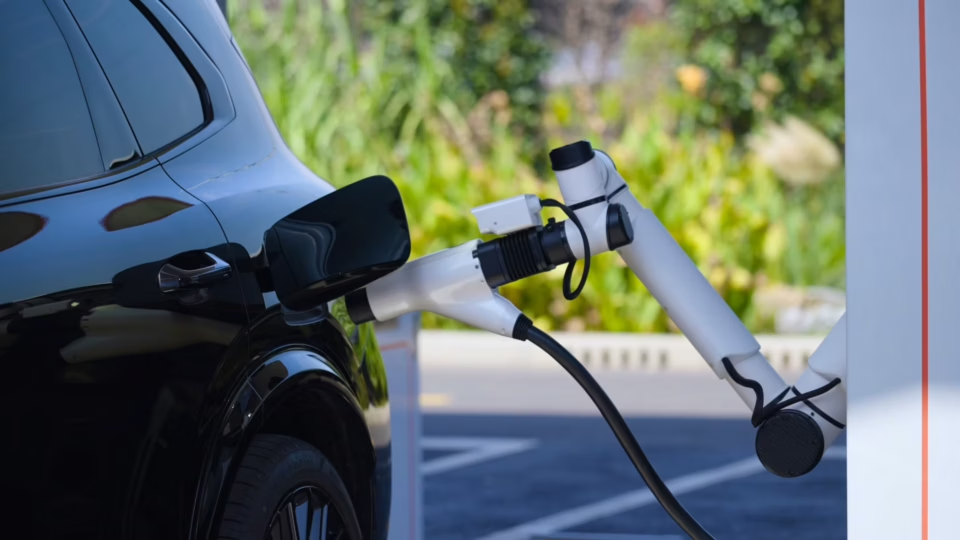
Geely Smart Charging is the automaker’s new high-power charging platform, presented with a headline output of up to 2,250 kW and a strong emphasis on thermal management, battery protection and intelligent allocation of available power.
What Geely Smart Charging actually promises
Geely Auto Group introduced the fifth generation of its charging technology on September 24, 2026. According to the company’s official newsroom announcement, the platform can deliver a peak charging power of 2,250 kW under suitable conditions. Geely also published a demonstration in which a compatible vehicle moved from 10 to 70 percent state of charge in four minutes and 30 seconds. Those figures describe a controlled test with the required vehicle, battery, charger and grid connection; they should not be read as a universal result for every electric car.
Why the 2,250 kW number needs context
A charging station’s maximum output is only one part of the chain. The car must accept the voltage, current and charging curve, while the battery management system decides how much energy can be safely taken at each moment. Temperature, state of charge and battery condition also affect the result. Peak power is usually available for a limited part of a session, not from empty to full. For buyers, the more useful questions are how long strong power is sustained, how much range is added in ten minutes and how consistently the system performs in hot or cold weather.
Cooling and battery management matter
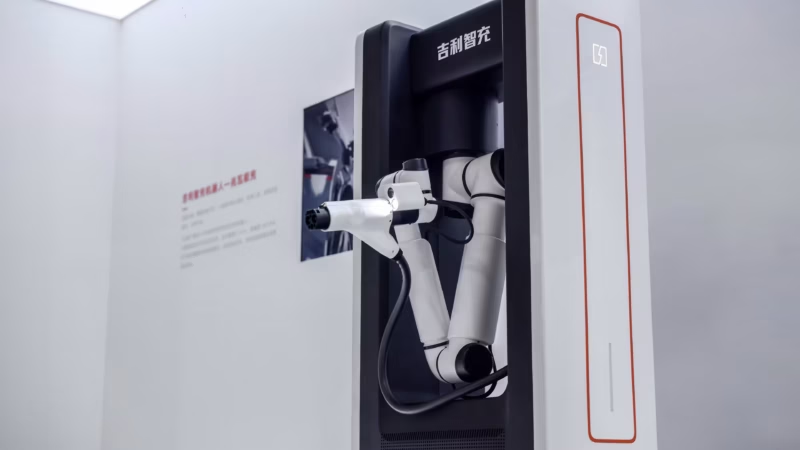
Geely says the platform combines liquid-cooled charging hardware with intelligent control that coordinates the vehicle, charger and energy network. At this level of power, heat must be removed from the cable, connector, power electronics and battery pack. Software can reduce current when sensors detect limits, then raise it again when conditions allow. That approach is more important than a single record figure because repeatable charging depends on the whole thermal system. It also explains why an older or incompatible vehicle cannot gain the advertised speed simply by connecting to a new station.
Infrastructure is the biggest practical constraint
Multi-megawatt charging requires far more than installing a familiar roadside cabinet. A site needs an adequate grid connection, transformers, power electronics, cooling, safety systems and often local energy storage. Operators must also plan for several vehicles arriving at the same time. Dynamic power sharing can prevent one connector from monopolising the site, but total capacity still has a hard limit. Deployment will therefore be selective at first, concentrated where demand and electrical infrastructure justify the investment. Availability in China does not automatically mean the same timetable for Europe or other markets.
What drivers should check before relying on it
Drivers should confirm that a specific vehicle supports the required architecture and that the station appears in an official network or navigation database. Charging speed shown on a product page may differ from the rate displayed during a real session. It is useful to compare the starting battery percentage, ambient temperature and time spent above a meaningful power level. Price per kilowatt-hour, idle fees and payment options also matter. A four-minute laboratory-style result is impressive, but a dependable route needs working chargers, transparent tariffs and enough stalls to avoid a queue.
Don’t miss this


What this means for the wider EV market
Geely’s announcement increases pressure on charging and vehicle manufacturers to treat speed as a system problem rather than a contest over one number. Higher power can reduce stops on long journeys, but only when vehicles, batteries and infrastructure evolve together. It may also shift attention toward reliability, thermal performance and station utilisation. Readers following electric mobility can find related coverage in SajberSfera’s electric vehicle section. The most meaningful evidence will come from commercial sites serving many drivers over time, not a single demonstration.
SajberSfera assessment
Geely Smart Charging is technically significant because the published 2,250 kW ceiling shows how quickly charging hardware is moving beyond today’s mainstream passenger-car systems. However, the claim is conditional: only compatible vehicles under appropriate conditions can approach the demonstrated curve. Until rollout locations, supported models, prices and independent field measurements are available, the correct conclusion is that Geely has presented a powerful platform, not that every EV can now charge in under five minutes.
Key points
- Geely announced a charging platform with a peak output of up to 2,250 kW.
- A company demonstration charged a compatible vehicle from 10 to 70 percent in four minutes and 30 seconds.
- Real results depend on the vehicle, battery, temperature, charger, grid and sustained charging curve.